


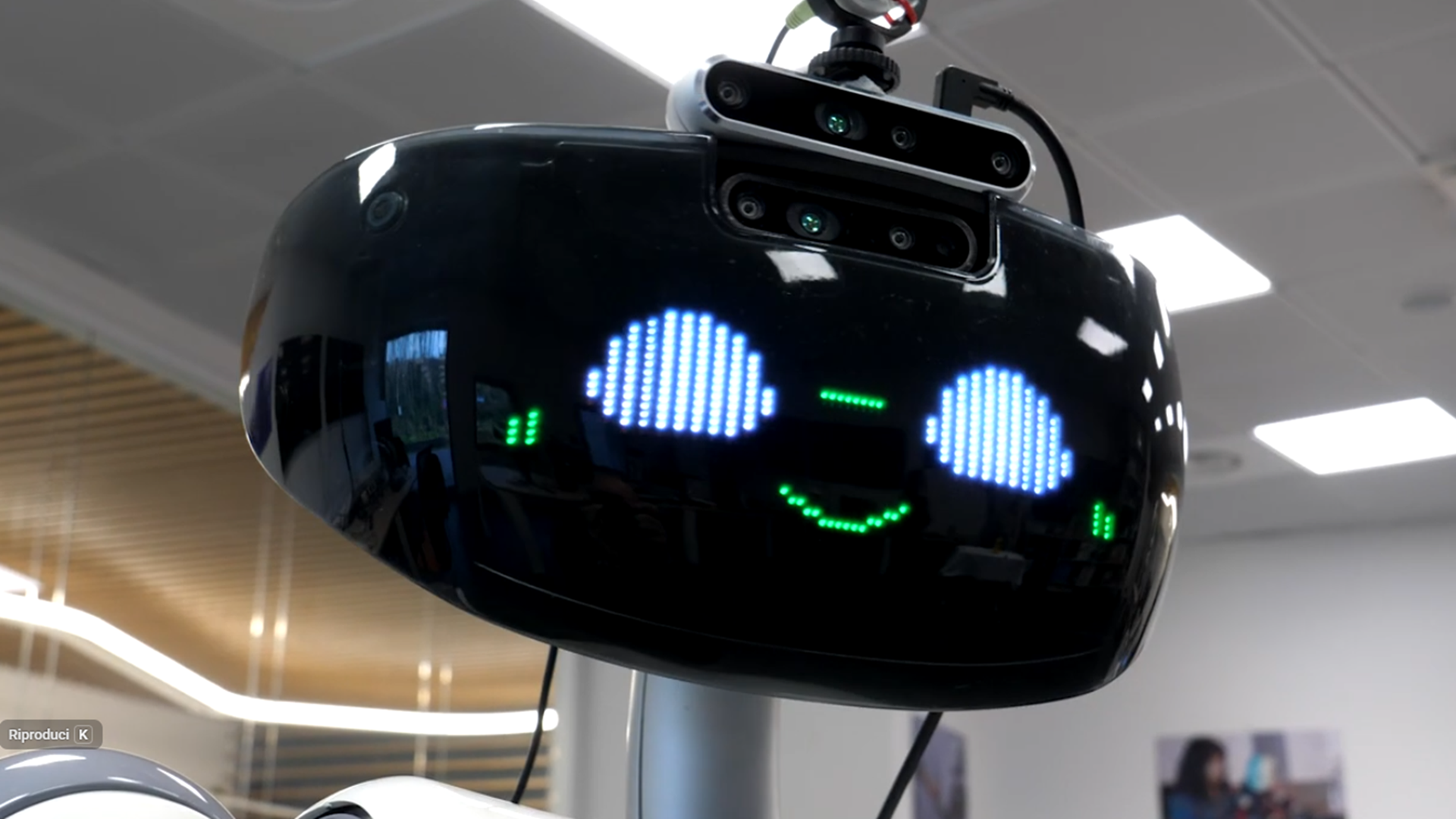
Within the innovation ecosystem RAISE – Robotics and AI for Socio-economic Empowerment, research in robotics has led to the development of new solutions capable of integrating artificial intelligence with smart environments.
Among these, R1 stands out: a service robot developed at the Italian Institute of Technology, designed to operate in everyday contexts such as homes, healthcare facilities, and public spaces dedicated to reception and information services.
Throughout the RAISE activities, researchers and technicians from the IIT’s Humanoid Sensing and Perception research line worked on advancing R1’s capabilities within Spoke 2, focused on urban technologies for inclusive environments. The team contributed to Work Package 1, focusing on the evolution of the robot as an assistant capable of interacting with both people and digital infrastructures.
“We are here with R1, our service robot, to showcase the activities carried out within the project,” explained Ettore Landini, Senior Technician in the HSP (Humanoid Sensing and Perception) research line, during a demonstration of the applications developed. The team designed R1 as a domestic and informational assistant, capable of operating in homes, hospital halls, and information points.
The work involved several research groups within the RAISE ecosystem. In particular, the team collaborated with the Pattern Analysis and Computer Vision (PAVIS) laboratory to integrate the robot into a smart environment, where sensors and AI systems collect data and transform it into useful services for people. In this context, R1 played a central role: it acted as a physical agent capable of receiving information from the digital environment and acting directly within the real world.
The researchers focused on two main capabilities. The first concerns voice interaction: R1 can understand commands expressed in natural language and engage in intuitive dialogue with users. This approach enables even non-expert users to interact with the robot and request services easily and immediately.
The second area of development concerns object manipulation. The robot has acquired the ability to recognize and grasp objects in its environment and move them according to user requests. During demonstrations, R1 identified an object on a table through its vision system, picked it up, and transported it to a location indicated by the user.
On the monitor connected to the robot, it was possible to observe in real time what R1 perceived through its sensors: the surrounding environment, the table, and the object identified by the computer vision system. Once the grasping task was completed, the robot transported the object to the designated location and then returned to its starting position.
The team conducted experimental tests at the Center for Human Technologies at IIT in Erzelli (Genoa), where they validated the software architecture for autonomous navigation in structured environments. Tests with volunteers made it possible to assess the effectiveness of interactions and the robot’s ability to move safely within different spaces.
The story of R1 began in 2016 in Genoa, with the completion of the first prototype. In the following years, the project evolved both hardware and software, leading to the current version, which found in the RAISE program an ideal context for experimenting with new applications related to everyday life.
Through these activities, RAISE has demonstrated how robotics can become a concrete component of the smart environments of the future. R1 represents an example of integration between artificial intelligence, robotic perception, and services for people, opening new scenarios for assistance, information, and support in cities and care environments.


