
Ecorobotics in complex industrial environments: integrating autonomous robots, electronic noses, and drones to enhance safety


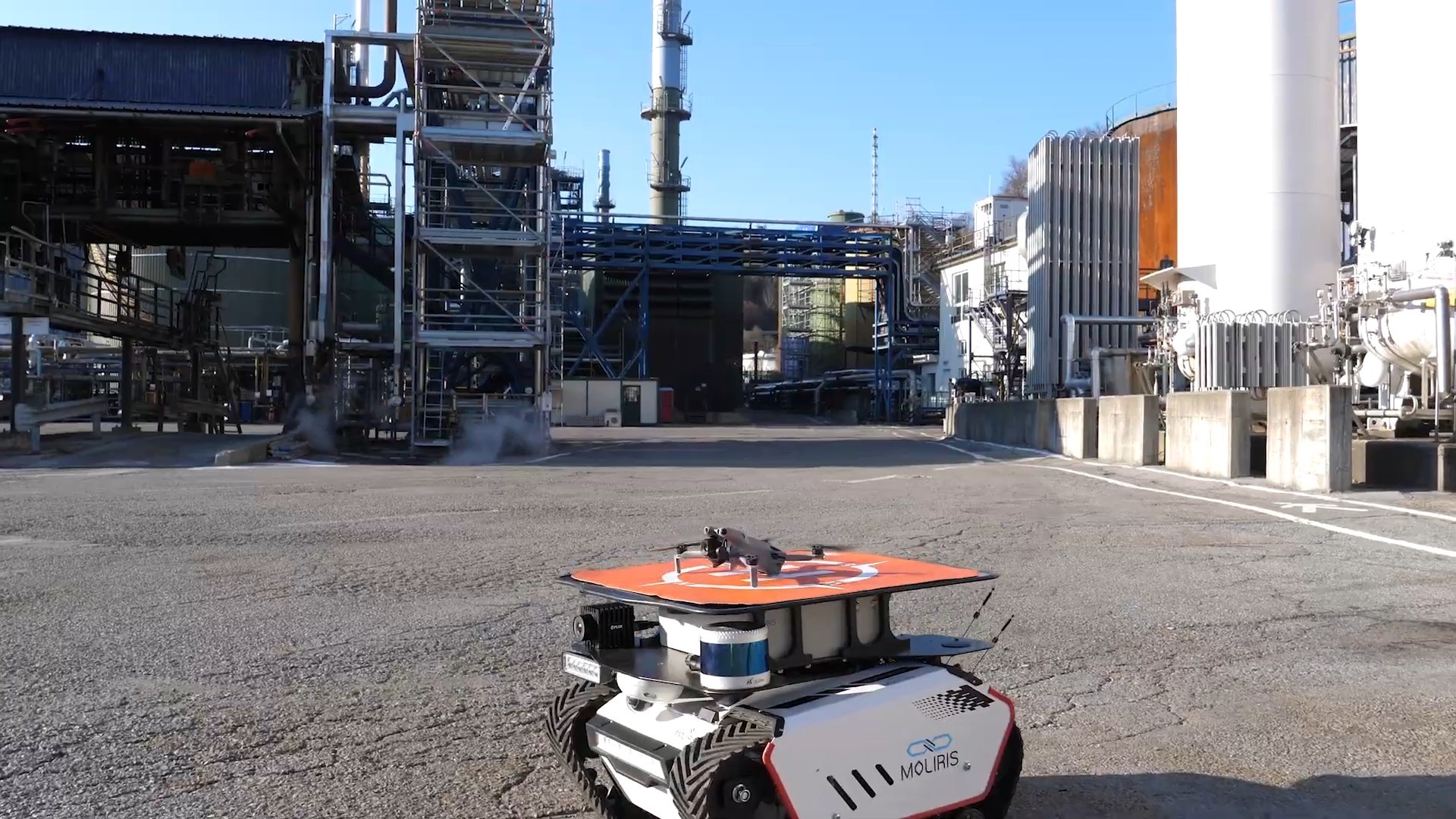
Spoke 3 of the RAISE project has tested advanced ecorobotics solutions for monitoring complex, fragile, and high-risk industrial environments.
One of the most significant applications was developed within the Project 2 of Spoke 3, in collaboration with the MESSAPI project, one of the winners of the cascade funding call promoted by Spoke 5.
The main objective of the experimentation was to make environmental monitoring in industrial contexts more efficient and accurate, contributing to the early detection of anomalies and the prevention of potential incidents.
In this context, ecorobotics emerges as an integrated approach combining ground-based autonomous robots, aerial drones, advanced sensing technologies, and artificial intelligence models. This effort is further supported by research activities carried out by the Department of Computer Science, Bioengineering, Robotics and Systems Engineering (DIBRIS) of the University of Genoa.
The experimentation was conducted at the IPLOM plant in Busalla, the lead partner of the MESSAPI project. Here, alongside the existing network of fixed sensors, mobile monitoring solutions based on autonomous robots and drones were introduced. These systems are capable of patrolling the infrastructure and collecting data in areas not covered by traditional sensor networks.
Among the deployed solutions, MOLIRIS, developed by Info Solution S.r.l., integrates an autonomous navigation system designed for complex industrial environments. This system enables the robot to operate even in the absence of GPS signals, maintaining localization capabilities and continuous movement despite obstacles or environmental changes.
The robot is equipped with advanced sensors for environmental monitoring and industrial safety, including:
– a thermal camera for detecting temperature anomalies;
– an electronic nose, developed within MESSAPI project (by Apphia S.r.l.), for detecting airborne substances of interest.
These technologies significantly improve monitoring activities and enhance the safety of both infrastructure and personnel.
In addition to the ground robot, aerial drones were also deployed, capable of collecting data from a complementary perspective and contributing to the creation of a digital twin of the plant. The combination of aerial surveys, photogrammetric modeling, and advanced computer vision techniques enables the generation of up-to-date and dynamic 3D representations, useful for continuous monitoring and intervention planning.
This experimentation represents a concrete example of ecorobotics applied to industrial environments, demonstrating how collaboration between research and industry can lead to the development of autonomous robotic solutions for monitoring, safety, and the management of complex infrastructures.
The activities were carried out within Product 2 of Spoke 3, involving research and industrial partners including the University of Genoa – DIBRIS, Info Solution, ETT, and ENEA, with support from the MESSAPI project.
MESSAPI includes Iplom S.p.A. (lead partner), SIGE S.r.l., PM_TEN S.r.l., and Apphia S.r.l.
Cover image
Author (video still): Marzio Cardellini (Bluframe)
Credits: RAISE


