


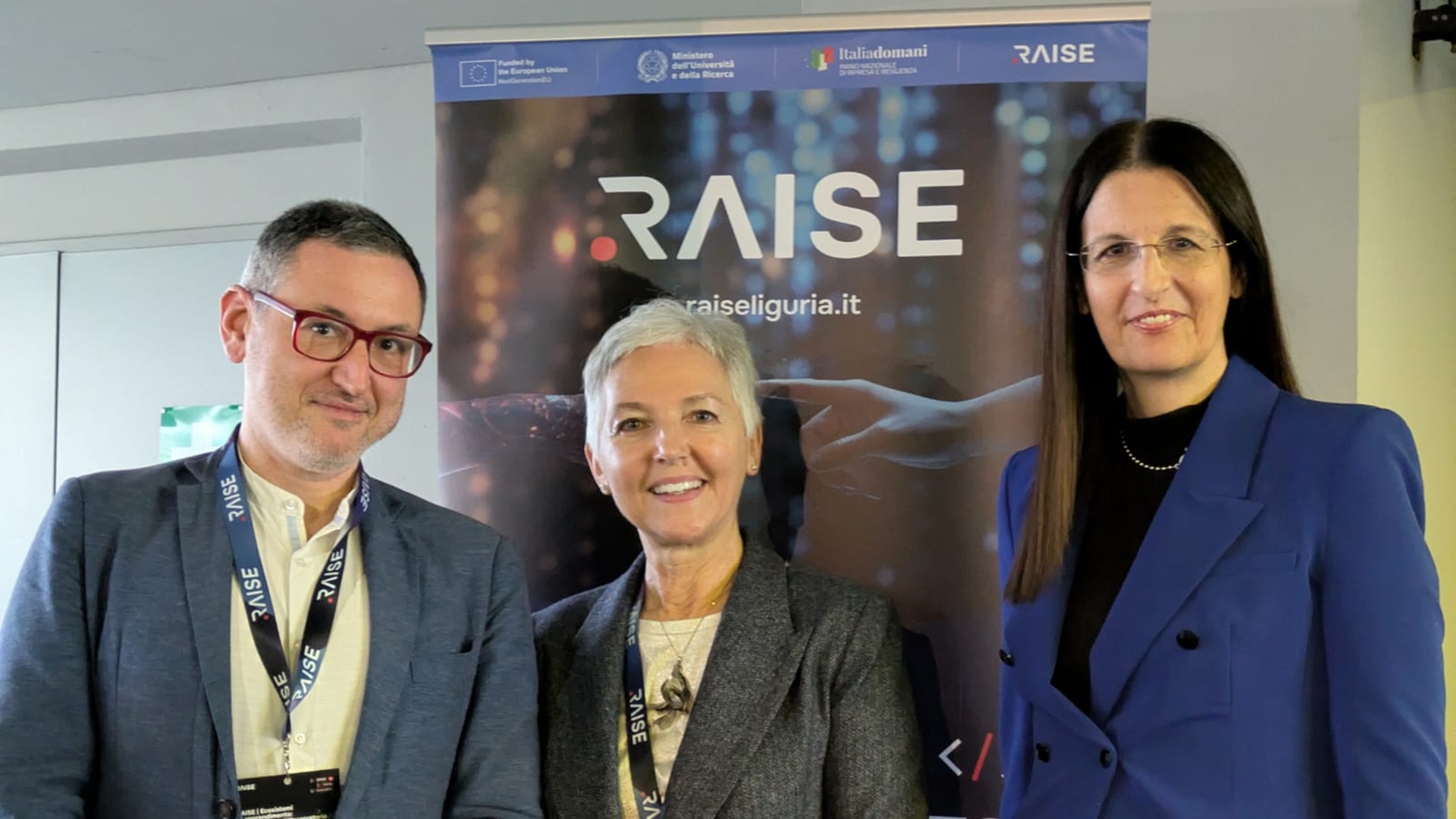
On Thursday, December 4, the Nautilus Hall of the Genoa Aquarium hosted the RAISE meeting Learning Ecosystems: the Contribution of the Observatory and Training, as part of Spoke 5.
The initiative brought together scholars and local representatives for an engaging discussion on the transformations affecting research and intelligent technologies. The two keynote lectures expanded the conversation by offering original and complementary perspectives on the future of AI.
The first speaker was Margherita Pagani, Director of the SKEMA Center for Artificial Intelligence at SKEMA Business School and Professor of Human-Centered Artificial Intelligence and Digital Marketing. In her talk, AI with Purpose: From Business Creativity to Ecology, Health, and Education, Pagani illustrated how artificial intelligence is broadening the scope of creativity in business and individual pathways.
She concluded her presentation by saying: “Artificial intelligence generates new ways to stimulate both corporate and individual creativity. If applied appropriately, it connects many of the topics I have presented with the objectives of RAISE.” She added: “We are exploring how AI can pursue a purpose, a goal, a mission, and in particular, how it can benefit society, ecology, healthcare, and education.”
Margherita Pagani’s keynote provided a clear overview of AI’s potential as a transversal driver of evolution, capable of creating value in services, digital platforms, and experiential engagement processes.
The second keynote, Artificial Intelligence and Robotics: A Slow Apprenticeship, was delivered by Fulvio Mastrogiovanni, Associate Professor at the University of Genoa, Vice Rector for International Relations, and Coordinator of the International Master’s Degree in Robotics Engineering. With extensive experience in robotics and two spin-offs founded within the university, Mastrogiovanni outlined an evolutionary framework that intertwines science, design, and everyday impact. He remarked: “An interesting aspect of the evolution of artificial intelligence and robotics is their pervasive nature: they are part of our lives even in areas where we do not realize it.” He then encouraged a long-term perspective: “I believe it is necessary to start thinking of artificial intelligence as something that exists and will continue to exist in the future, and especially to understand how to make the most of it. In a very broad sense, humans and intelligent technologies will develop together.”
Nicoletta Buratti, Associate Professor of Economics and Business Management and organizer of the event for Spoke 5 of RAISE, commented: “For me, it was important to invite these two keynote speakers, as they allowed us to start the day with two different perspectives on the importance of investing in research on these topics. We heard how AI, particularly from a managerial standpoint, can support business processes that enhance competitiveness and the development of applications aimed at people’s well-being. We talked about AI for Purpose, meaning artificial intelligence focused on solving real-world problems. Professor Margherita Pagani, Director of the Center for Artificial Intelligence at SKEMA Business School in Paris, presented this perspective very clearly. Professor Fulvio Mastrogiovanni, a cognitive roboticist, offered a broader reflection: he invited us to consider the origins of the human desire to create machines ‘like us’ and provided a historical, and sometimes provocative, overview leading up to the present.”
Today presents both great opportunities and significant questions. While innovations in robotics and AI can truly provide solutions to humanity’s challenges, concerns also arise regarding scenarios that could lead to a dystopian future. For this reason, it is essential to pay careful attention and always include ethical reflection in everything we do.”


